

California Crane Inspection & Certification Requirements
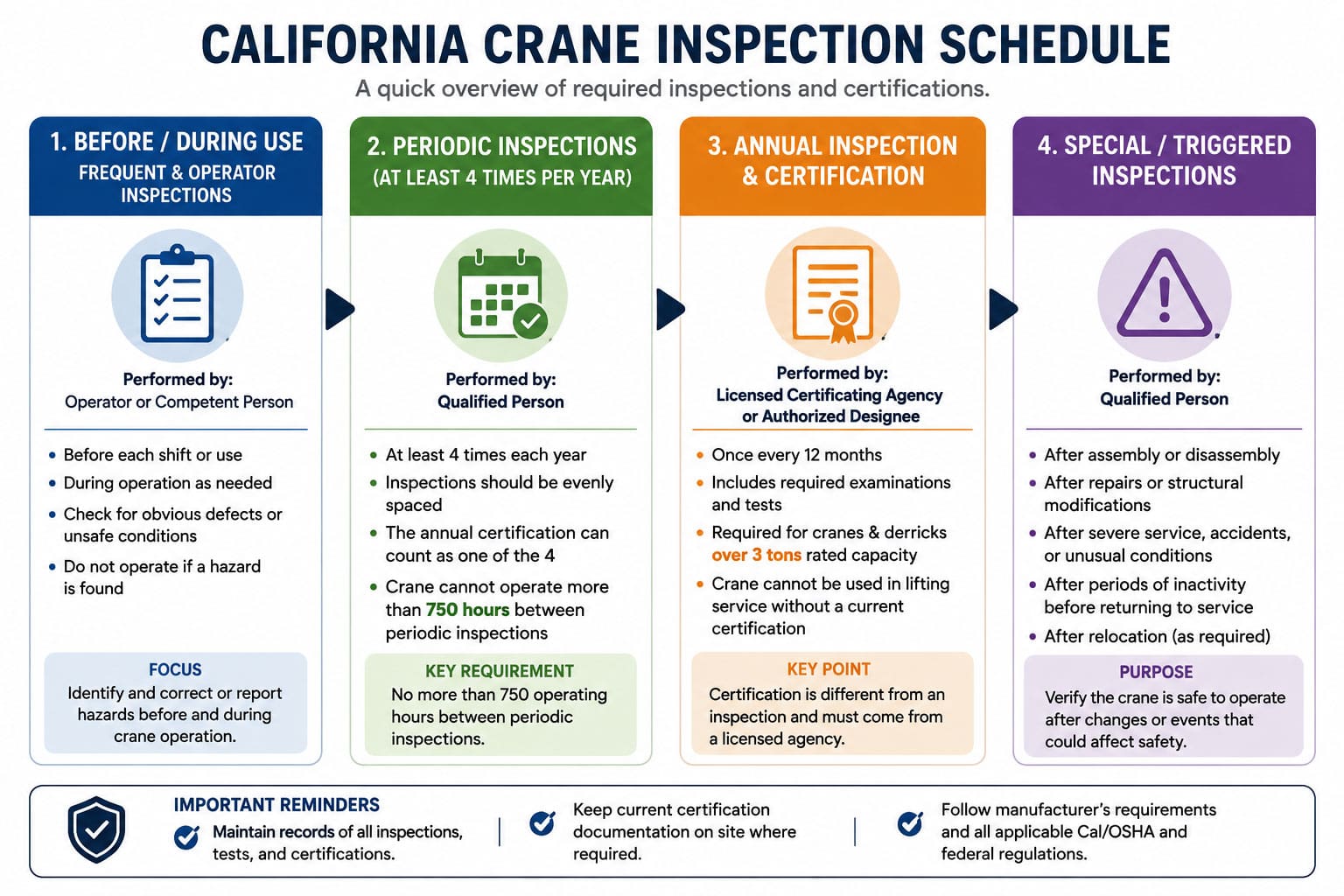
Crane inspections are an essential part of safe crane operation, but in California they are also subject to requirements that go beyond the federal OSHA baseline.
Employers operating cranes in California may need to comply with requirements for frequent inspections, periodic inspections, annual examinations and testing, crane certification, and inspections following certain events or changes to the equipment.
Inspection ≠ Certification
One particularly important distinction is that inspecting a crane and certifying a crane are not necessarily the same thing. California requires certain cranes to be certified through a licensed certificating agency, while other routine inspections may be performed by qualified or competent personnel.
Below is an overview of the major crane inspection and certification requirements California employers and crane operators should understand.
Are Crane Inspections Required in California?
Yes. California employers are required to ensure that cranes and derricks are inspected at specified intervals and under certain circumstances.
The exact requirements depend on factors such as:
- The type of crane or derrick
- The crane’s rated capacity
- How frequently the equipment is used
- Whether it has recently been assembled, altered, repaired, or relocated
- Whether the crane has been subjected to unusual conditions
- Whether the equipment is a tower crane or another specially regulated type of crane
Federal OSHA crane inspection requirements may also provide an important baseline, particularly under 29 CFR 1926.1412 for cranes used in construction.
Daily or Frequent Crane Inspections
Crane operators and employers should not assume that an annual inspection means the crane requires no attention during the rest of the year.
Cranes must be routinely inspected for conditions that could create a safety hazard.
Depending on the equipment and applicable regulation, frequent inspections may include items such as:
- Operating mechanisms
- Control systems
- Hooks and latches
- Wire rope
- Hydraulic and pneumatic systems
- Electrical components
- Safety devices
- Limit switches
- Brakes
- Tires, tracks, outriggers, and supporting components
- Signs of deterioration, deformation, excessive wear, or damage
The operator also plays an important role in identifying obvious deficiencies before and during operation.
If an inspection identifies a condition that creates a safety hazard, the fact that the crane has a current annual certification does not mean the crane can simply continue operating.
Necessary corrections must be made as required before the equipment is returned to service.
California Periodic Crane Inspections
One of the more significant differences between California requirements and the federal OSHA baseline is California’s periodic inspection system.
Under Title 8 §5031 , covered cranes are subject to periodic inspections at least four times each year.
These inspections should be approximately evenly spaced throughout the year.
The annual certification examination may serve as one of the required periodic inspections. This effectively creates a schedule in which a crane is examined throughout the year rather than relying solely on one annual inspection.
California also places an operating-hour limitation on the inspection interval.
A crane generally cannot operate for more than 750 hours between periodic inspections.
This means a heavily utilized crane could require a periodic inspection sooner than would otherwise be expected based solely on the calendar.
Four Times Per Year Does Not Always Mean Every Three Months
It is tempting to describe California’s requirement simply as a “quarterly crane inspection.”
While that is useful shorthand, the regulation is more precise.
Periodic inspections are required at least four times annually, should be approximately evenly spaced, and the crane cannot exceed the applicable 750-hour operating interval.
For employers operating cranes heavily, tracking operating hours is therefore an important part of maintaining compliance.
Annual Crane Inspection and Certification
California’s annual crane requirements are especially important because an annual crane inspection and an annual crane certification should not automatically be treated as interchangeable terms.
Under 8 CCR §5021 , cranes and derricks exceeding the applicable rated-capacity threshold generally may not be used in lifting service unless the employer has verified that the equipment has a current certification.
For many cranes, the key threshold is a rated capacity greater than three tons.
The required annual examination and testing associated with certification must be performed through a currently licensed certificating agency or an authorized designee of that agency.
This is an important California-specific requirement.
Simply having a knowledgeable mechanic, crane operator, or other qualified person inspect the crane does not necessarily satisfy California’s certification requirement when the equipment is subject to §5021.
Inspection vs. Certification: What’s the Difference?
These terms are sometimes used interchangeably in the crane industry, but California employers should understand the distinction.
An inspection generally involves examining the crane and its components for defects, excessive wear, damage, improper operation, or other unsafe conditions.
A certification is a formal determination made under California’s certification requirements that the crane has been examined and tested as required and is certified for use.
Depending on the inspection involved, an operator, competent person, qualified person, mechanic, or other properly qualified individual may be permitted to perform it.
California crane certification, however, is subject to separate requirements involving licensed certificating agencies and their authorized designees.
In other words:
A crane may have been inspected without necessarily being certified.
Employers should determine which requirement applies rather than assuming that an inspection performed by a qualified employee automatically satisfies the state’s annual certification requirement.
Who Can Certify a Crane in California?
California regulates the individuals and organizations permitted to perform required crane certification work.
Where certification is required, the annual tests and examinations generally must be performed by a certificating agency currently licensed by the California Division of Occupational Safety and Health (Cal/OSHA), or by a properly authorized designee of that agency.
California’s regulations also establish requirements concerning the duties and records of certificating agencies.
This is another area where California’s requirements can be more specific than the general federal OSHA requirement for an annual/comprehensive inspection to be performed by a qualified person.
Inspections After Repairs or Modifications
Annual and periodic inspections are not the only times a crane may need to be examined.
Additional inspection or testing requirements can be triggered when equipment has been:
- Structurally modified
- Repaired
- Altered in a manner affecting safe operation
- Reassembled
- Subjected to conditions that could have damaged critical components
- Returned to service following certain periods of inactivity
The extent of the required inspection or testing depends upon what was changed and the applicable regulation.
Repairs or modifications involving load-bearing components, structural members, controls, safety devices, or other critical systems should receive particular attention before the crane returns to lifting operations.
Crane Inspections After Assembly
Assembly and disassembly introduce their own hazards.
For cranes that must be assembled or configured at a jobsite, applicable requirements may call for inspection after assembly and before operation.
The purpose is to verify that components have been installed correctly, required pins and fasteners are in place, the crane has been configured according to manufacturer requirements, and safety devices and operational systems function correctly.
This becomes particularly important for equipment such as lattice-boom cranes and tower cranes, where significant structural assembly occurs before the crane can operate.
Cranes That Have Been Idle
A crane that has been sitting unused should not automatically be assumed to be ready for service.
Depending on the length of time the crane has been idle and the applicable regulation, additional inspection may be necessary before the equipment returns to operation.
Potential problems can include corrosion, deterioration of wire rope, hydraulic leakage, damaged electrical components, weather exposure, degraded lubricants, and other conditions that may develop while equipment is stored.
The longer a crane remains inactive, the more extensive the required examination may become.
Tower Crane Inspection and Certification Requirements
Tower cranes are subject to particularly extensive requirements in California.
California regulations require fixed and mobile tower cranes to undergo specified examinations, tests, and certification.
Fixed tower cranes may also require certification following erection at a new site.
California additionally requires certain nondestructive testing (NDT) as part of the certification process for fixed tower cranes. This testing can apply to critical structural components and welds where failure could have severe consequences.
Tower cranes are also subject to California operating-permit requirements and other regulations beyond the inspection requirements applicable to many mobile cranes.
Employers working with tower cranes should therefore review the regulations specifically applicable to tower-crane erection, operation, inspection, testing, certification, and permitting rather than relying only on the general mobile-crane requirements.
OSHA
Federal – 1926 Subpart CC
Federal OSHA’s construction crane standard, particularly 29 CFR §1926.1412 , establishes several inspection categories, including:
- Shift inspections
- Monthly inspections
- Annual/comprehensive inspections
- Post-assembly inspections
- Inspections following modifications
- Inspections following repairs or adjustments
- Inspections of equipment that has been idle
- Inspections following certain severe-service conditions
Under the federal standard, the annual/comprehensive inspection must generally be performed at least once every 12 months by a qualified person.
California retains extensive inspection requirements but adds its own state-specific certification and periodic inspection framework.
Cal/OSHA (Title 8) – California vs Federal Crane Inspection Requirements
The distinction can be summarized broadly as follows:
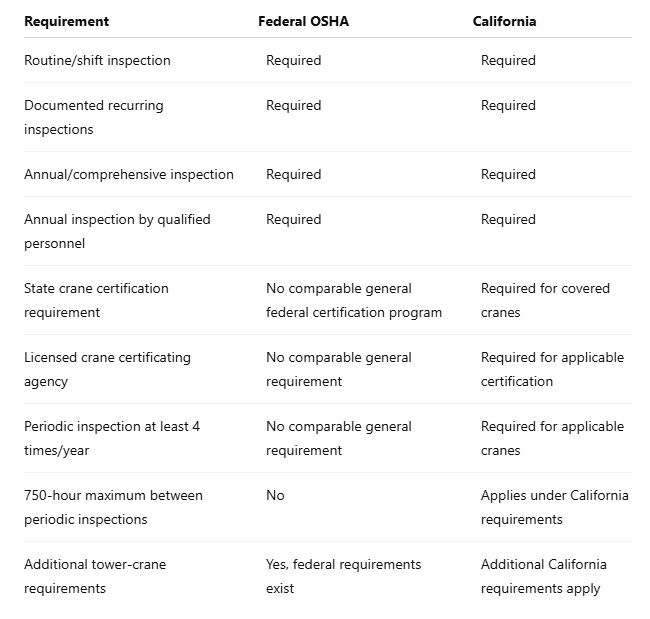
Because crane type, capacity, industry, and application can change which regulations apply, this table should be considered a general comparison rather than a substitute for determining the requirements applicable to a particular crane.
Does a Crane Operator Perform the Inspection?
Sometimes – but not every inspection.
Crane operators have an important role in inspecting equipment and identifying unsafe conditions. Operators should be familiar with the items they are expected to observe before and during crane operation.
However, being a certified crane operator does not automatically qualify someone to perform every inspection, examination, test, or certification required by California law.
Different requirements may call for an:
- Operator
- Competent person
- Qualified person
- Qualified technician
- Licensed certificating agency
- Authorized designee of a certificating agency
Employers should therefore identify both what inspection is required and who is legally qualified to perform it.
Keep Crane Inspection and Certification Records
Documentation is another important component of crane compliance.
Depending on the applicable inspection or certification requirement, records may need to identify information such as:
- Crane or equipment identification
- Date of inspection
- Person or agency performing the inspection
- Components examined
- Deficiencies discovered
- Corrective actions taken
- Tests performed
- Certification status
Employers should maintain required records and ensure that current certification documentation is available where required.
Good recordkeeping also makes it considerably easier to track periodic inspection intervals and the 750-hour operating limitation.
Key Takeaway for California Crane Owners and Operators
Crane inspection requirements in California involve much more than simply having someone “look over the crane” once a year.
Depending on the crane and how it is used, compliance may involve routine inspections, periodic inspections throughout the year, annual examinations and testing, formal crane certification, and additional inspections following repairs, modifications, assembly, inactivity, or unusual conditions.
California’s requirements for certain cranes to be certified through a licensed certificating agency—as well as its periodic inspection requirements—are particularly important differences from the general federal OSHA framework.
Crane owners, employers, supervisors, and operators should understand not only when a crane must be inspected, but also who is permitted to perform each inspection and when formal California crane certification is required.
Regulatory References
- California Title 8 §5021 — Equipment Over Three Tons Rated Capacity
Requires cranes and derricks used in lifting service exceeding three tons rated capacity to have current certification. Required annual tests and examinations must be conducted by a currently licensed certificating agency or listed designee.
View Cal/OSHA §5021 - California Title 8 §5031 — Inspection
Establishes California’s daily, periodic, and annual/comprehensive crane inspection requirements. Periodic inspections must be performed at least four times annually at approximately regular intervals, and cranes may not be operated more than 750 hours between periodic inspections.
View Cal/OSHA §5031 - California Title 8 §§344.60–344.67 — Crane and Derrick Certifier Licensing Requirements
Establishes California’s licensing requirements for individuals and agencies engaged in required testing, examination, and certification of cranes and derricks.
View Cal/OSHA §344.60 - California Title 8 §344.80 — Certifier Duties and Recordkeeping Requirements
Establishes testing, examination, certification, supervision, and recordkeeping responsibilities for California-licensed crane and derrick certifiers.
View Cal/OSHA §344.80 - California Title 8 §344.81 — Fixed and Mobile Tower Crane Certification
Establishes certification requirements specific to fixed and mobile tower cranes, including annual certification, certification following erection or certain relocations, and specified nondestructive testing requirements for fixed tower cranes.
View Cal/OSHA §344.81 - California Title 8 §4965.1 — Tower Crane Inspections
Establishes additional pre-erection, post-erection, periodic, and annual inspection requirements specifically applicable to tower cranes.
View Cal/OSHA §4965.1 - Federal OSHA 29 CFR §1926.1412 — Inspections
Establishes federal construction-crane requirements for shift, monthly, annual/comprehensive, post-assembly, modified/repaired equipment, severe-service, and idle-equipment inspections.
View OSHA §1926.1412
Table of Contents
- Inspection ≠ Certification
- Are Crane Inspections Required in California?
- Daily or Frequent Crane Inspections
- California Periodic Crane Inspections
- Annual Crane Inspection and Certification
- Inspection vs. Certification: What’s the Difference?
- Who Can Certify a Crane in California?
- Inspections After Repairs or Modifications
- Crane Inspections After Assembly
- Cranes That Have Been Idle
- Tower Crane Inspection and Certification Requirements
- OSHA
- California vs Federal Crane Inspection Requirements
- Does a Crane Operator Perform the Inspection?
- Keep Crane Inspection and Certification Records
- Key Takeaway for California Crane Owners and Operators
- Regulatory References

California Crane Operator Salary
July 28, 2026
The following will display statistics that show statistics for the annual salary of crane operators in California. These will cover previous years, the most current data (2025), and growth over the last 5 years. The profession is considered healthy in demand and…
Ready to Enroll?
Give us a Ring!
High Demand & Job Security in a Growing Industry
The average employment growth rate for crane operators is 10% which is double the national average for all occupations. A variety of industries require crane operators such as: electrical, oil and drilling, construction, and more.
California Crane School has an extensive network of employers looking for a certified crane operator like you.

 We guarantee that you will pass your NCCCO Certification Written Exams or our class is FREE until you do.
Get NCCCO Certified Now
Contact Us Today!

 Industry Expert 20+ Years
 Dedicated Support & Training Team
 Classes Every Month of the Year
Eady to Get Certified
Contact Us Today!
Industry Pioneer 20+ Years
Dedicated Team of Professionals
Classes Monthly & Year-Round


Check out the great things our customers are saying about us


